

In brief
Sensitive skin reacts excessively to stimuli that other skin types tolerate: cold, heat, hard water, certain ingredients. It is not a separate skin type, but a characteristic that overlays dry, combination, or oily skin. The principle of a good routine can be summed up in three words: few products, few ingredients, high consistency. It is important to know that a natural ingredient is not automatically better tolerated than a synthetic one: essential oils and fragrances, including natural ones, are among the most frequent causes of reactions.
This is a subject on which natural cosmetics must be honest, even when it is inconvenient. The idea that natural is synonymous with gentle is widespread, and it is false. An essential oil is a concentrate of active molecules. A natural fragrance contains regulated allergens. Reactive skin does not distinguish between a molecule derived from a plant and one from a laboratory: it reacts to what irritates it, period.
This does not condemn natural cosmetics, far from it. It simply requires looking at the formulas rather than the promises. Here is how.

Sensitive skin or reactive skin: two distinct realities
The two terms are often used interchangeably, even though they describe different situations.
Sensitive skin is constitutionally so, and always has been. Its skin barrier is naturally thinner or more permeable, and its nerve endings are more reactive. It flushes easily, tingles upon contact with hard water, and tolerates temperature fluctuations poorly. This cannot be corrected; it must be managed.
Reactive skin, on the other hand, has become so. Often following excess: scrubs that are too frequent, active ingredients that are too powerful, harsh cleansers, or layering too many products. Its barrier is damaged, allowing irritants to pass through. The good news: this state can be repaired in a few weeks, provided you simplify your routine drastically.
In both cases, sensitivity overlays your skin type without replacing it. You can have dry and sensitive skin, combination and sensitive skin, or even oily and sensitive skin. If you have not yet identified your skin type, our 3-step test takes two hours.
How to know if your skin is sensitive?
A few signs, which must recur to be significant.
-
Redness that appears easily from cold, heat, physical exertion, or emotion.
-
Tingling or a sensation of heat upon applying skincare, even without visible redness.
-
Intolerance to hard water, with skin feeling uncomfortable after rinsing.
-
Frequent reactions to new products, often within the first three days.
-
Skin that clearly calms down when the routine is simplified.
The last point is the most telling. If your skin does better when you use fewer products, the question is no longer which one to add, but which ones to remove.

Why natural does not mean well-tolerated
This is the heart of the matter, and it deserves to be explained rather than just stated.
A plant does not produce its molecules to take care of our skin. It produces them to defend itself against insects, fungi, and predators. An essential oil is a concentrated extraction of these defense molecules: it is active, and this activity can be irritating to fragile skin.
The case of fragrances is particularly revealing. Among the allergenic substances that European regulations require to be declared on cosmetic labels, a large portion are components of natural origin, present in essential oils and floral extracts. Botanical origin offers no guarantee of tolerance.
This does not mean you have to give up olfactory pleasure. It means you have to know where to place it.
Ingredients to watch for when the skin reacts
No list is universal, as tolerance is individual. However, here are the families that appear most often.
|
Ingredient family |
What to know |
Action to take |
|---|---|---|
|
Essential oils |
Highly concentrated in active molecules, they are among the primary causes of reactions on reactive skin |
Avoid on the face in cases of proven sensitivity |
|
Fragrances, both natural and synthetic |
Many of the regulated allergens required to be declared are of natural origin |
Limit fragranced compositions on the face |
|
Citrus extracts |
Some are photosensitizing and can react to the sun |
Reserved for rinse-off products or evening applications |
|
Drying alcohol |
Weakens the skin barrier and increases reactivity over the weeks |
To be removed from face care |
|
Exfoliating scrubs |
Micro-abrasion maintains low-level inflammation |
Space out significantly, or replace with a gentle treatment |
|
Gentle plant butters and oils |
Well-tolerated in the vast majority of cases, they repair the barrier |
Recommended basis for a sensitive skin routine |
Conversely, gentle plant oils and butters constitute a reliable base. Sweet almond oil is traditionally used for delicate skin, shea butter restores the skin barrier, aloe vera provides hydration and comfort, and green tea supports skin prone to redness thanks to its antioxidant properties.

What "dermatologically tested" really means
It is a mention that we see everywhere and that few brands explain. It indicates that the finished formula was tested on a panel of volunteers, under the supervision of a dermatologist, in order to evaluate its skin tolerance. It is not a promise of an absolute absence of reaction—no formula can offer that—but it is a real and documented verification step. All our skincare products are subjected to this, and our About page details all our formulation commitments, in France, paraben-free and vegan.
A tip for reading labels: the list of ingredients is classified in descending order of concentration. An ingredient placed at the end of the list is present in a very small quantity. And the shorter the list, the fewer candidates there are for a reaction.
The sensitive skin routine, step by step
The principle is sobriety: fewer products, applied regularly, are always better than an elaborate routine applied intermittently.
|
Step |
The action |
What to avoid |
|---|---|---|
|
Cleansing |
Lukewarm water, gentle product, twice a day maximum |
Hot water, abundant foam, washcloth |
|
Morning routine |
A fluid texture on damp skin, applied with gentle pressure |
Layering several serums or active ingredients |
|
Evening routine |
A nourishing treatment that restores the barrier |
Introducing a new active ingredient at the same time as another |
|
Once a week |
Nothing, or a very gentle treatment if the skin is calm |
Exfoliating scrub, drying mask |
|
In case of flare-up |
Return to just two products for ten days |
Adding an additional soothing product |
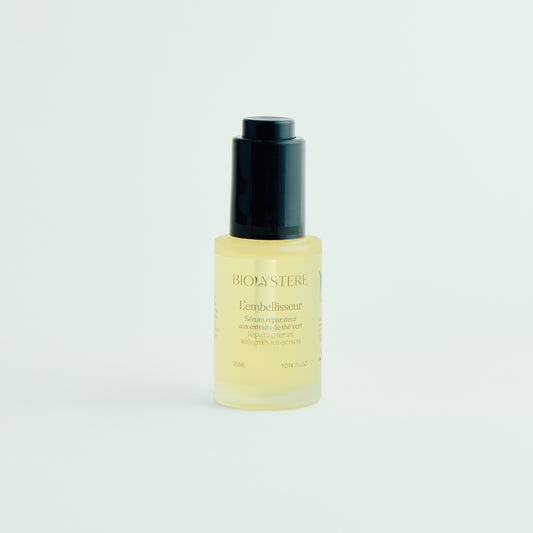
In practice, two products are enough: L’Hydratante in the morning, whose fluid texture is applied with gentle pressure rather than massage, and La Nourrissante in the evening to rebuild the barrier. The duo can be found in the L’Essentielle range. If your skin has been calm for several weeks and you wish to work on radiance, L’Embellisseur can be added in the evening, introduced alone and gradually.
On the question of choosing between hydration and nutrition, which poses itself differently on sensitive skin with a weakened barrier, our dedicated article provides the key: repair before replenishing.

How to test a new product risk-free
This is the method that avoids most unpleasant surprises, and it requires ten days.
-
Day 1: apply a small amount to the inside of the elbow, a thin and discreet area. Wait 24 hours.
-
Day 2: if there is no reaction, apply behind the ear or along the jawline. Wait another 24 hours.
-
Days 3 to 10: integrate the product into your routine, every other evening at first, then every evening.
-
During this entire period, do not introduce any other new products. This is the most important rule.
If you test two products at the same time and the skin reacts, you will never know which one to blame, and you may eliminate the one that actually suited you.
What to do when the skin reacts anyway?
The natural reflex is to add a soothing product. This is almost always a mistake, because it is one more product on already saturated skin.
The right response is subtractive: return to two products maximum, a gentle cleanser and a nourishing treatment, for ten days. Suspend everything else, including scrubs and makeup if possible. The skin usually calms down in a week. Then reintroduce only one product at a time, using the protocol described above.
Some situations, however, require medical advice rather than a routine adjustment: permanent and localized redness, patches that persist for several weeks, significant itching, or a violent and sudden reaction. A dermatologist will identify what no change in cream will resolve.
Frequently asked questions
Is sensitive skin a skin type?
No, it is a characteristic that overlays the four existing types. You can have oily and sensitive skin, which actually makes the routine more delicate to construct, since products typically intended for oily skin are often the most irritating.
Is fragrance-free essential?
On the face of reactive skin, it is a reasonable precaution, as fragrance is among the most frequent causes of reaction. On the body, tolerance is generally better, as the skin is thicker and less exposed there.
Can sensitive skin become less so over time?
Skin that has become reactive following an aggressive routine almost always regains its calm with a few weeks of simplification. Constitutional sensitivity does not disappear, but it manifests much less when the skin barrier is properly maintained.
Should all active ingredients be avoided when you have sensitive skin?
No, they must be introduced one by one, at a low frequency, and on skin whose barrier is already repaired. Order matters: repair first, add later. Starting with active ingredients on weakened skin almost always leads to failure.
Are redness and sensitive skin the same thing?
Not necessarily. Occasional redness from cold or after exertion is common. Established and permanent redness requires dermatological advice. Furthermore, skin that flushes easily may also lack water, which accentuates discomfort: dull complexion and reactivity often go hand in hand.
In summary
Sensitive skin doesn't require more sophisticated care, it requires less. Two well-chosen products, a short list of ingredients, a systematic test before trying anything new, and consistency. Our facial skincare products are gathered in the Face collection, all dermatologically tested.
And if any doubt persists about an ingredient, the rule is simple: when in doubt, leave it out. Sensitive skin rarely forgives overzealousness, but it almost always rewards consistency.