

In brief
The first signs of aging on the face generally appear between the ages of 25 and 35, starting around the eye contour. Not all of these are wrinkles: a dehydration line fades with two to three weeks of regular hydration, whereas an expression line follows the movement of the face. An effective routine is based on four pillars: daily sun protection, constant hydration, a nourishing treatment in the evening during nocturnal regeneration, and consistency. No cosmetic treatment can erase an established wrinkle, but supple, hydrated skin makes them visibly less noticeable.
There comes a morning when you notice a small line at the corner of your eye that doesn't quite disappear when you stop smiling. It is rarely dramatic, often appears earlier than expected, and generally triggers two opposite reactions: doing nothing at all, or suddenly buying a complete routine of six products.
Both are mistakes. Here is how to know what you are dealing with, what actually works, and what is mostly marketing.

Not all marks are wrinkles
This is the first thing to establish, because the response required differs depending on what you are observing.
|
Type of mark |
How to recognize it |
What helps |
|---|---|---|
|
Dehydration line |
Fine, horizontal, on the cheeks. Fades after applying a moisturizer |
Daily hydration, result in two to three weeks |
|
Expression line |
Follows a facial movement: smiling, frowning. Visible mostly during movement |
Skin suppleness and nutrition, consistency |
|
Established wrinkle |
Visible at rest, stable relief. Eye contour, furrows |
Nutrition, sun protection, long-term night care |
|
Loss of elasticity |
Loss of firmness around the jawline, not a crease but sagging |
Massage, firming treatments, professional advice if desired |
The test is simple: apply your usual skincare and look again twenty minutes later. A dehydration line fades significantly; an established wrinkle does not move. Many women who think they are seeing their first wrinkles are actually observing skin that lacks water, which is very common when returning from summer and is corrected quickly.
Why does skin show signs of aging over time?
Three mechanisms combine, and it is useful to know which one you can influence.
The first is the slowing down of collagen and elastin synthesis, the two proteins that give skin its firmness and elasticity. This slowing down begins discreetly around age 25 and continues steadily thereafter. It is constitutional.
The second is a decrease in sebum production, more marked after 40 and especially after menopause. Skin that is less rich in lipids retains less water, becomes drier, and dry skin shows signs of aging more easily. Cosmetics compensate for this well.
The third is cumulative sun exposure, and this is by far the most influenceable factor. UV rays degrade collagen and elastin fibers much faster than time alone. This is the reason why the skin on the face and hands shows signs of age long before areas that are never exposed.

At what age should you start?
The question comes up constantly, and the answer is less spectacular than one might hope: as soon as the skin shows signs, and not before. Anti-aging routines started at twenty on skin that does not need them are primarily a waste of money, and sometimes a source of reactivity.
|
Period |
What changes in the skin |
Priority of the routine |
|---|---|---|
|
25 to 30 years |
Collagen synthesis begins to slow down, first fine lines appear |
Daily hydration and sun protection |
|
30 to 40 years |
Slower cell renewal, less luminous complexion |
Add a night treatment and work on radiance |
|
40 to 50 years |
Decrease in sebum production, drier and less firm skin |
Enhanced nutrition, richer textures in the evening |
|
After 50 years |
Thinner, drier skin, slower healing |
Nutrition, gentleness, and unwavering consistency |
One point to remember: sun protection cannot wait. It is the only measure whose preventive effect is genuinely established, and it is useful at any age.
The 4 pillars of a natural anti-aging routine
An effective routine does not require ten products. It requires four principles maintained over time. Our products are formulated and manufactured in the south of France, are vegan, paraben-free, and dermatologically tested, as detailed on our About page.
1. Sun protection, every day
This is the first anti-aging step, and by far the most effective. It is not just about beach days: UVA rays pass through windows, reach the skin on overcast days, and are active all year round. Daily protection on the face, hands, and décolleté does more for skin suppleness than any targeted treatment.
2. Hydration, without interruption
Hydrated skin is supple skin, and supple skin shows fewer signs of aging. It is mechanical: dehydration lines add to the real marks and visibly accentuate the overall appearance. L'Hydratante should be applied in the morning to skin that is still slightly damp, without forgetting the neck and eye contour, two areas where the skin is thinner and shows signs of age first.
3. Nutrition, in the evening
The night is the regeneration window: cell renewal intensifies and water loss reaches its maximum. This is the time when a rich treatment delivers the best results. La Nourrissante rebuilds the barrier, and the Night Repair Range focuses efforts on this specific phase. The day and night duo is combined in the L'Essentielle range.
If the distinction between hydrating and nourishing does not seem obvious, it becomes decisive after forty, when the skin loses lipids: our dedicated article explains it in detail.
4. Work on radiance as much as relief
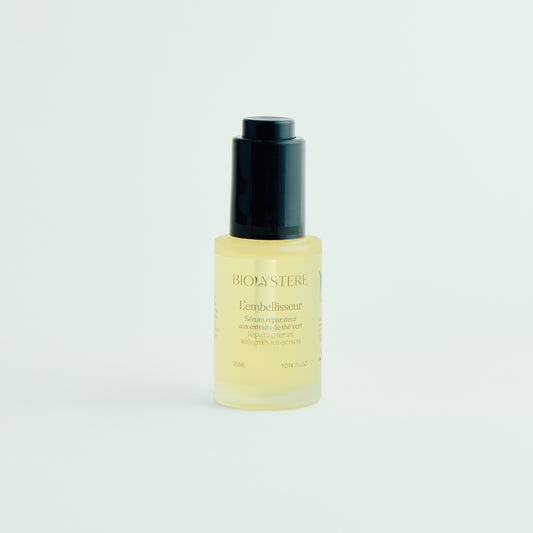
This is the pillar that is forgotten, yet it changes perception significantly. A luminous complexion gives an impression of freshness that counts for more than the softening of a two-millimeter fine line. L'Embellisseur should be applied in the evening before your cream, to clean skin. The subject of radiance is developed in our article on dull complexions.

Natural ingredients that support mature skin
Green tea is particularly relevant here: its polyphenols help the skin defend itself against oxidative stress, one of the factors of skin aging. Hibiscus oil is traditionally associated with suppleness and radiance, shea butter restores the barrier of skin that produces less sebum, and sweet almond oil softens while remaining very well tolerated.
Aloe vera rounds out the set regarding hydration. A note on more powerful active ingredients: they have their place, but on skin whose barrier is solid. On skin that has become reactive, they often aggravate the situation they claim to correct.

Areas that are systematically forgotten
The eye contour first. The skin there is significantly thinner than on the rest of the face and almost devoid of sebaceous glands: it is mechanically the first area to show signs of age. Apply your treatment with light tapping motions using your ring finger, the finger that exerts the least pressure.
The neck and décolleté next. They receive as much sun as the face and almost never any treatment. Simply extend your application downward, without buying an extra product.
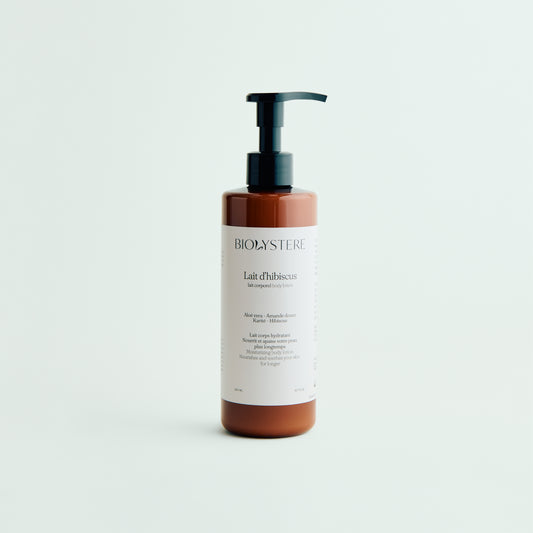
The hands finally, which betray age more than the face because they combine sun exposure, repeated washing, and lack of protection. A rich cream in the evening makes a big difference over a year. This subject will be the object of a dedicated article, and Hibiscus Milk works well in the meantime on both body and hands.
What does not work, or works less well than advertised
-
Treatments promising to erase wrinkles. No cosmetic fills in an established wrinkle. It makes the skin more supple and luminous, which reduces the appearance of the texture, and that is already a lot.
-
Intensive treatments of a few weeks. The skin does not function in terms of cures: it responds to consistency over months.
-
Stacking active ingredients. Two powerful active ingredients applied together often neutralize each other and weaken the barrier. Use only one at a time, introduced gradually.
-
Frequent exfoliation for smoothing. The effect is immediate and the result the opposite in the medium term, as a damaged barrier makes signs of age more prominent.
-
Waiting for wrinkles to start sun protection. This is the only measure whose benefit is truly preventive, so it is the only one that must be anticipated.
Habits that count as much as skincare
Sleep, because skin regeneration is nocturnal and cannot be caught up on. Sleeping on your back also limits pillow creases, the effect of which on facial lines is real over the years.
Tobacco, whose impact on the skin is among the best established: it reduces irrigation of micro-vessels and accelerates collagen degradation.
Diet finally, rich in fruits, colored vegetables, and good fatty acids, which provides the skin with the antioxidants it needs. The effect is not visible in a month; it is visible over several years.
Frequently asked questions
At what age should one start an anti-aging routine?
Around 25 to 30 years old for daily hydration and night care, as soon as the first fine lines appear. Sun protection should be practiced at any age without waiting for any signs.
Can a cream make a wrinkle disappear?
No, and no serious brand promises this. A cosmetic treatment hydrates, nourishes, and softens, which significantly reduces the appearance of fine lines and makes established wrinkles less visible. The texture itself is not removed.
Is a specific cream for the eye contour necessary?
Not necessarily at the beginning. A gentle treatment applied delicately to this area is sufficient in most cases. A dedicated eye cream becomes useful when the skin there is significantly drier than on the rest of the face, which generally happens later.
Can expression lines be avoided?
They are part of facial movement and expressiveness. Supple, well-hydrated skin shows them less deeply, but trying to suppress them with cosmetics is like hoping to smile less. The approach has its limits, and its value.
Are natural anti-aging treatments just as effective?
On the pillars that really count—hydrating, nourishing, protecting—yes. Vegetable oils and butters effectively restore the skin barrier. Regarding disruptive active ingredients, natural cosmetics offer fewer solutions, which is something to know before choosing your path.
In summary
Start by identifying what you see: a dehydration line is corrected in three weeks; a wrinkle requires long-term support. Then maintain the four pillars: sun protection, hydration, nocturnal nutrition, radiance. Our facial treatments are grouped in the Face collection, and our skin type test will help you choose the textures that suit you.
Consistency does more than the price of the bottle. A simple routine applied every day for five years far outperforms a sophisticated routine maintained for three months.