

In brief
Combination skin combines an oily T-zone (forehead, nose, chin) with normal to dry cheeks. The right routine isn't about treating these two areas separately with opposing products, but about hydrating the entire face with a fluid texture, simply adjusting the amount: a thin layer on the T-zone, more generous on the cheeks. Cleanse a maximum of twice a day, with a gentle product, and banish anything that dries out the skin: harsh cleansing increases sebum production instead of reducing it.
It’s the most common skin type, and paradoxically the one that receives the least appropriate care. Combination skin gives the impression of having two faces: a nose that shines by late morning, and cheeks that feel tight after showering. The result is that people buy one product for the oily area and another for the dry area, and neither gives satisfaction. If you haven't yet definitively identified your skin type, start with our 3-step test: combination skin is also the one most often confused with oily skin.
Good news: the balance of combination skin is rarely restored by adding products. It's restored by removing what aggresses it.

What exactly is combination skin?
The density of sebaceous glands is not uniform on the face. It is naturally higher on the forehead, nose, and chin, the famous T-zone, and much lower on the cheeks and temples. In combination skin, this difference is simply more pronounced than average.
Concretely, this results in a face with two regimes: a T-zone that produces sebum in abundance, with visible pores and sometimes blemishes, and cheeks that lack lipids and dehydrate easily. Both situations coexist within a few centimeters, which explains why a rich cream can suffocate the nose while a too-light texture leaves the cheeks feeling unsatisfied.
One point to remember: combination skin is not a milder form of oily skin. It is a distinct type, requiring a strategy of modulation rather than correction.
How do you know if your skin is truly combination?
The test is simple and takes two hours. Cleanse your face in the morning, apply no skincare products, wait, then press a tissue successively on your nose, then on a cheek.
-
Oily trace on the nose, clean tissue on the cheek: combination skin.
-
Oily trace in both cases: oily skin.
-
No trace anywhere, with a feeling of tightness: dry skin.
It is the difference between the two impressions that indicates combination skin, not the shine itself. You can find the complete method, including the conditions to respect to ensure accurate results, in the article dedicated to skin types.

Why over-cleansing your T-zone worsens the problem
It’s the most natural, yet most counterproductive, reflex. When faced with a shiny area, we cleanse more, use mattifying products, and increase exfoliation. The relief is immediate, but the backlash arrives within hours.
The mechanism is simple: when the hydrolipidic film is removed, the skin perceives an attack and compensates by producing more sebum. The more you strip your skin, the shinier your T-zone becomes, and the more you strip it. This cycle often sets in within a few weeks, and it takes about the same amount of time to break free from it.
A second, less visible effect: these aggressive products are applied to the entire face, including the cheeks, even though they don't need them. Combination skin that is poorly treated thus becomes both shiny and sensitive, with redness on the dry areas.
The combination skin routine, morning and evening
The principle can be summarized in one sentence: a single product for the entire face, applied in modulated quantities. Our formulas are designed with this in mind, made in France, vegan, paraben-free, and dermatologically tested, a point you can find on our About Us page.
In the morning: light cleansing, hydration everywhere
A lukewarm water rinse is often sufficient in the morning. Pat dry, then apply The Hydrator to the entire face: a thin layer on the forehead, nose, and chin, a more generous application on the cheeks, neck, and eye contour. Its fluid texture, based on sweet almond oil, penetrates without leaving a greasy finish, which also makes it a good base before makeup.
Contrary to persistent intuition, hydrating the T-zone does not make it shine more. Properly hydrated skin better regulates its sebum production: this is precisely the desired result.
Finish with sunscreen if you are going out. UV rays thicken the stratum corneum, which closes pores over sebum and promotes imperfections in the T-zone.
In the evening: gentle makeup removal, targeted treatment if needed
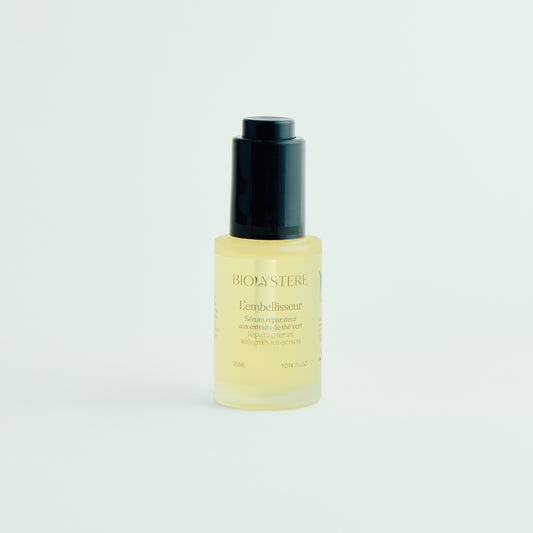
Remove makeup with a milky or oily texture, rinse with lukewarm water. Then apply The Enhancer, whose serum texture is well-suited for combination skin that doesn't tolerate rich creams at night. On the cheeks, if they feel tight in winter, you can add a dab of The Nourisher specifically to that area.
This is the flexibility of a well-thought-out routine: the same duo serves combination and dry skin, only the distribution changes. The two essential treatments are combined in The Essential range, and The Night Repair range takes over when the skin requires more overnight repair.
Once a week: exfoliate, without excessive zeal
A gentle weekly exfoliation frees up pores in the T-zone and smooths skin texture. Focus lightly on the nose and its sides, graze the cheeks, and immediately apply your moisturizing product. More than once a week, you'll restart the vicious cycle described above.

Do you really need two different creams?
In the vast majority of cases, no. The two-product approach, a mattifying cream on the T-zone and a rich cream on the cheeks, sounds appealing on paper but poses two concrete problems: the textures inevitably meet at the boundaries of the zones, and the budget doubles for a benefit that is rarely noticeable.
Quantity modulation solves the problem in nine out of ten cases. Reserve the use of two distinct products for very pronounced situations: a T-zone with persistent imperfections combined with flaking cheeks, for example. And even in this case, it's about adding a targeted treatment to a small area, not doubling the entire routine.
Habits to reconsider for combination skin
|
Common habit |
What works instead |
|---|---|
|
Cleansing two or three times a day to control the T-zone |
Maximum two gentle cleansings, morning and evening, with lukewarm water |
|
Skipping cream on the forehead and nose |
Apply a thin layer everywhere: an area deprived of water produces more sebum |
|
Using mattifying paper several times a day |
Occasional blotting, without rubbing, and without touching the skin afterwards |
|
Multiplying purifying products over the entire face |
Target only the T-zone, and leave the cheeks alone |
|
Exfoliating several times a week |
A gentle weekly exfoliation, immediately followed by a moisturizing treatment |

What active ingredients should you prioritize, zone by zone?
|
Zone |
To prioritize |
To avoid |
|---|---|---|
|
T-zone (forehead, nose, chin) |
Regulating active ingredients, fluid textures, light hydration |
Drying alcohol, abrasive grain scrubs, occlusive textures |
|
Cheeks |
Hydration, soothing active ingredients, light fatty substances |
|
|
Whole face |
Gentle cleansing, daily sun protection |
"Clear skin effect" products that promise immediate results |
Among natural ingredients, green tea is a particularly relevant ally for combination skin: its antioxidant and soothing properties support skin prone to excess sebum without drying it out. Aloe vera provides water and comfort to dry areas, while shea butter is reserved for the cheeks and never applied to the T-zone.
Adapting your routine to the seasons
Combination skin behaves differently depending on the season. In summer, heat increases sebum production: lighten quantities even further and space out rich textures. In winter, cold air and heating dry out the cheeks while the T-zone continues to shine, which accentuates the contrast. This is the time to add a nourishing treatment, but only on the cheeks, and in the evening.
This seasonal contrast is normal and does not mean that your skin type has changed. It reflects an adjustment in the skin's condition.
Frequently Asked Questions
Can you have combination and sensitive skin?
Yes, and it's common, especially among people who have long used drying products on the T-zone. Sensitivity overlaps with skin type: it doesn't require changing texture, but rather simplifying the composition and introducing only one new product at a time.
My skin gets oily by midday despite cream: what should I do?
First, check your cleanser. Rapid shine after applying a suitable product almost always comes from over-stripping cleansing in the morning, which triggers sebum overproduction. Switch to a lukewarm water rinse for two weeks and observe the difference.
Should I use a clay mask?
On the T-zone only, and no more than once a week. Applied to the entire face, clay dries out the cheeks and further unbalances the skin. Remove the mask before it cracks: completely dry clay continues to absorb, including water from the skin.
Does combination skin change with age?
It generally diminishes. As sebum production gradually decreases from the age of thirty, many combination skins become normal, then dry. The routine should then be enriched accordingly, without waiting for tightness to set in.
Does makeup worsen combination skin?
Not in itself, but two habits make it problematic: applying foundation to unhydrated skin, which accentuates irregularities in the T-zone, and incomplete makeup removal. Thorough makeup removal in the evening is more important than the choice of makeup product.
In summary
Combination skin doesn't require two routines or an arsenal of mattifying products. It calls for moderation: gentle cleansing, generalized hydration in modulated quantities, weekly exfoliation, and abandoning anything that promises to control shine in one go. You'll find all our face care products in the Face collection, categorized by need rather than by promise.
Allow three to four weeks for balance to return. That's how long it takes for skin accustomed to defending itself to understand that it can stop doing so.