

In short
Day cream and night cream do not serve the same need. During the day, the skin defends itself against cold, pollution, UV rays, and dehydration: it needs a light treatment that hydrates and protects. At night, it loses more water and accelerates its renewal: it benefits from a richer treatment that nourishes. Dry, mature, and dehydrated skin types significantly benefit from using both. Oily skin can settle for a single light treatment morning and evening.
On a bathroom shelf, the question often comes up: are two jars really useful, or is it a marketing invention to sell two products instead of one? The honest answer is somewhere in between. For some skin types, the day and night duo truly changes daily comfort. For others, a single well-chosen treatment is enough.
To decide, one must understand a simple fact: your skin is not doing the same work at 10 a.m. as it is at 3 a.m.

By day, the skin defends itself; by night, it repairs itself
The skin follows a twenty-four-hour biological rhythm, just like sleep or digestion. This is what we call cutaneous chronobiology, and it explains why the same product does not have the same utility depending on the time of day.
During the day: a shield role
By day, the skin is in defense mode. It faces temperature fluctuations, wind, dry air from heating or air conditioning, pollution, and UV rays. Sebum production is higher, which helps the skin barrier limit water loss. The ideal treatment is therefore light, absorbs quickly, does not shine, and does not interfere with makeup.
During the night: a repair role
At night, the situation reverses. Cell renewal intensifies, microcirculation increases, and the skin loses more water through evaporation because the skin barrier is more permeable in the evening. This is when it most needs to be nourished, and when it best absorbs rich textures, as no makeup or external aggression is there to disrupt them.
This is the whole point of a night cream: to support this regeneration work, rather than simply "hydrating a second time."
Day cream and night cream: the differences
|
Day cream |
Night cream |
|
|---|---|---|
|
Main role |
Protect and maintain hydration against daily aggressions |
Nourish and support the skin's natural regeneration |
|
Texture |
Light, absorbs quickly, makeup-friendly |
Richer, more enveloping, longer absorption time |
|
Typical ingredients |
Hydrating agents, antioxidants, sometimes solar filters |
Plant butters and oils, nourishing lipids |
|
Moment |
In the morning, after cleansing |
In the evening, on clean, makeup-free skin |
|
Sensation sought |
Comfort without shine |
Supple and rested skin upon waking |
|
Common mistake |
Choosing one that is too rich: the complexion shines by midday |
Choosing one that is too light: the skin feels tight upon waking |
This distinction aligns with the often-confused difference between hydrating and nourishing. Day cream primarily provides water and helps retain it; night cream primarily provides lipids. If the nuance seems blurry, we have detailed it in our article on the difference between hydrating and nourishing your skin.

What a good day cream should do
An effective day cream checks three boxes. It hydrates, so that the skin remains supple and comfortable until evening. It is unobtrusive, with a texture that melts in seconds and does not leave a greasy film. Finally, it prepares the skin for the rest of the day, serving as a makeup base and limiting the sensation of tightness.
This is the role of L'Hydratante, our day cream, formulated with sweet almond oil, an ingredient known for its gentleness and good tolerance. Its light texture is suitable for normal, combination, and dry skin, and can be applied in a few simple motions in the morning.
An important point: a hydrating day cream does not replace dedicated sun protection. On days of exposure, and all year round if your skin marks easily, apply sunscreen as the final step of your morning routine.
What a good night cream should do
A night cream doesn't have to be discreet: it has several hours ahead of it. It must nourish, by providing lipids that strengthen the skin barrier and limit nighttime water loss. It must envelop, with a more generous texture that leaves the skin supple upon waking. And it must respect the skin, since it remains in contact with it throughout the night.
La Nourrissante, our night cream, is based on shea butter, renowned for its nourishing properties. It is the treatment to apply in the evening to wake up to rested skin, without any feeling of tightness.
Can you use the same cream morning and evening?
Yes, in some cases, and it is more honest to say so. Young, normal to oily skin that never feels tight upon waking can very well get by with a single light treatment, applied morning and evening.
On the other hand, reversing the roles rarely works:
-
A night cream in the morning: the rich texture often makes the complexion shine by midday and makeup does not hold as well.
-
A day cream in the evening: it is not harmful, but the skin lacks nutrition when it needs it most. On dry skin, this results in tightness upon waking.
The right indicator is simple: if your skin feels tight upon waking, if it looks dull in the morning, or if you feel the need to reapply cream mid-day, you are likely missing a richer night treatment.

Do you really need a night cream? It all depends on your skin
|
Skin type |
Night cream essential? |
What we recommend |
|---|---|---|
|
Dry |
Yes |
A rich treatment in the evening, a hydrating treatment in the morning. This is the skin type that benefits most from the duo. |
|
Dehydrated |
Useful |
Priority on hydration morning and evening, a more nourishing treatment in the evening if the skin feels tight upon waking. |
|
Combination |
Depending on areas |
Light treatment in the morning on the whole face, night treatment on the cheeks and eye contour. |
|
Oily |
Rarely |
A single light treatment morning and evening can suffice. In the evening, avoid textures that are too occlusive. |
|
Sensitive |
Useful |
Two treatments with short ingredient lists, well-tolerated, introduced one after the other. |
|
Mature (40+ years) |
Yes |
Sebum production decreases: a nourishing treatment in the evening becomes a real comfort. |
Unsure about your skin type? Start with our 3-step test to determine your skin type: it only takes a few minutes and a mirror. You will then find a detailed routine for dry skin and for combination skin.
The day and night routine, step by step
In the morning: hydrate and protect
-
Cleanse gently, with lukewarm water or a mild cleanser. In the morning, the skin does not need intensive cleansing.
-
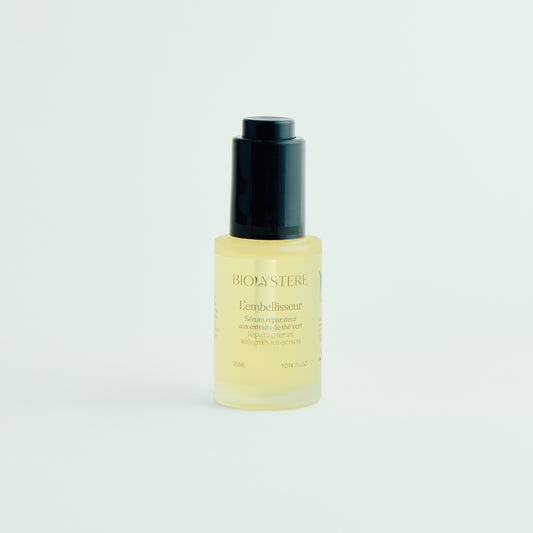
Apply a serum if needed. L’Embellisseur, our vitamin C serum, is ideally used in the morning for complexion radiance.
-
Apply the day cream, a pea-sized amount of L’Hydratante warmed between the palms, then pressed onto the face and neck.
-
Finish with sun protection on days of exposure.
In the evening: cleanse and nourish
-
Remove makeup and cleanse thoroughly: a night treatment applied to skin still laden with makeup or pollution loses a large part of its benefit.
-
Apply the night cream, La Nourrissante, by massaging from the center of the face outward, not forgetting the neck.
-
Let absorb for about ten minutes before going to bed, so that the treatment stays on the skin and not on the pillowcase.
To simplify, we have brought these two treatments together in the L’Essentielle range: L’Hydratante in the morning, La Nourrissante in the evening, designed to work together. For skin needing a more targeted nightly treatment, especially after 40, the Gamme Réparatrice Nuit takes over. We explain how to build a routine adapted to the first signs of aging in our article on the natural anti-aging routine.
Errors that cancel out the duo's benefits
-
Layering too many products: two creams and one serum are enough. Beyond that, the skin saturates and textures may pill.
-
Applying night cream right before sleeping: a few minutes of waiting makes a difference.
-
Changing products too often: skin needs three to four weeks to show the effects of a routine. Regularity matters more than the product.
-
Choosing a night cream that is too rich for combination skin: apply it only to dry areas, cheeks, and eye contour.
Introducing two new products at once on reactive skin: in case of discomfort, it's impossible to know which one is responsible. Our advice on testing a new product on sensitive skin details the right method.
Treatments designed to work together
At BIOLYSTERE, our facial treatments are formulated and manufactured in the south of France, with ingredients of natural origin, vegan, paraben-free, and dermatologically tested. Rather than multiplying references, we have chosen a short routine, where each product has a clear role. This is what you will find in our Face collection, and this is the spirit of our approach: returning to the essentials and supporting the skin in what it already knows how to do.
Frequently Asked Questions
What is the difference between a day cream and a night cream?
Day cream is light and hydrating: it helps the skin defend itself against daily aggressions and serves as a makeup base. Night cream is richer and more nourishing: it supports the skin's natural regeneration during sleep, when it loses more water.
Can you use day cream at night?
Yes, it is not harmful. But on dry, mature, or dehydrated skin, day cream does not provide enough lipids for the night, and the skin may feel tight upon waking. On oily or young skin, a single light treatment morning and evening may suffice.
From what age should you use a night cream?
There is no set age: it is the skin type that decides. Dry skin can benefit from it in your twenties. For others, the need often arises between 30 and 40, when sebum production begins to decrease and the skin feels tighter upon waking.
How long should you wait between applying night cream and going to bed?
About ten minutes is enough. This allows time for the product to penetrate rather than ending up on your pillow, and it’s a great opportunity for a moment of relaxation before sleeping.